
Reference 16610 · IFREMER Issue · French Deep Sea Research
The IFREMER Submariner 16610
IFREMER and a Rolex Submariner
The Organisation
IFREMER
IFREMER (Institut Français de Recherche pour l’Exploitation de la Mer, Issy-les-Moulineaux, France) is a French company similar to COMEX — involved with deep sea exploration and research. The company (ifremer.fr) was formed in 1984 after the merger of another dive company called CNEXO (Centre National pour l’Exploitation des Océans, Paris, France).
IFREMER has a special relationship with the French government: it receives state support but is permitted to pursue deep sea exploration independently and generate a for-profit business alongside its research mandate.
Full Name
Institut Français de Recherche pour l’Exploitation de la Mer
Founded
1984 (merger of CNEXO)
Headquarters
Issy-les-Moulineaux, France
Predecessor
CNEXO — Centre National pour l’Exploitation des Océans, Paris
Primary DSV
Nautile — rated to 6,000m / 19,685ft
vs. COMEX
COMEX holds the record with 20+ DSVs
Website
Historic Mission
The Discovery of the RMS Titanic
While IFREMER has many missions and accolades, one of the most memorable was their involvement as part of the team that discovered the wreckage of the RMS Titanic in 1985. The team was led by Dr. Robert Ballard and included members of IFREMER, the US Navy, National Geographic, and the Woods Hole Oceanographic Institute.
IFREMER was also involved in raising part of the wreckage in later recovery missions in 1987, 1993, 1994, and 1996. More recently, in 2003, the submersible Nautile was deployed at the request of Spanish authorities in support of the wreckage recovery of the Spanish tanker Prestige.

Photo of the RMS Titanic Discovery Team, 1985.
Left to right: Jean-Louis Michel (IFREMER) · Lt. George Ray (US Navy) · Jean Jerry (IFREMER) · Bob Ballard · Bernard Pillaud (IFREMER)
© Woods Hole Oceanographic Institution
The Issued Watch
The IFREMER 16610
As with many other deep sea diving companies, IFREMER assigned equipment to their divers and researchers — and some were issued Rolex Submariners as their diving and research instruments.

IFREMER Issued Rolex Submariner 16610 · Issue Number XX on Caseback
Photos Ed Delgado
This watch was assigned to a researcher and has an issue number engraved on the caseback. Unlike watches assigned to COMEX, the IFREMER pieces are clearly standard production Submariners without any technical modifications — the only distinguishing feature being the issue number, possibly applied by IFREMER at the time of assignment.
Unlike COMEX watches, IFREMER Submariners received no case modifications. They are standard 16610s distinguished solely by the caseback engraving — making provenance documentation essential to authenticating an example.
Provenance
Documentation & Papers
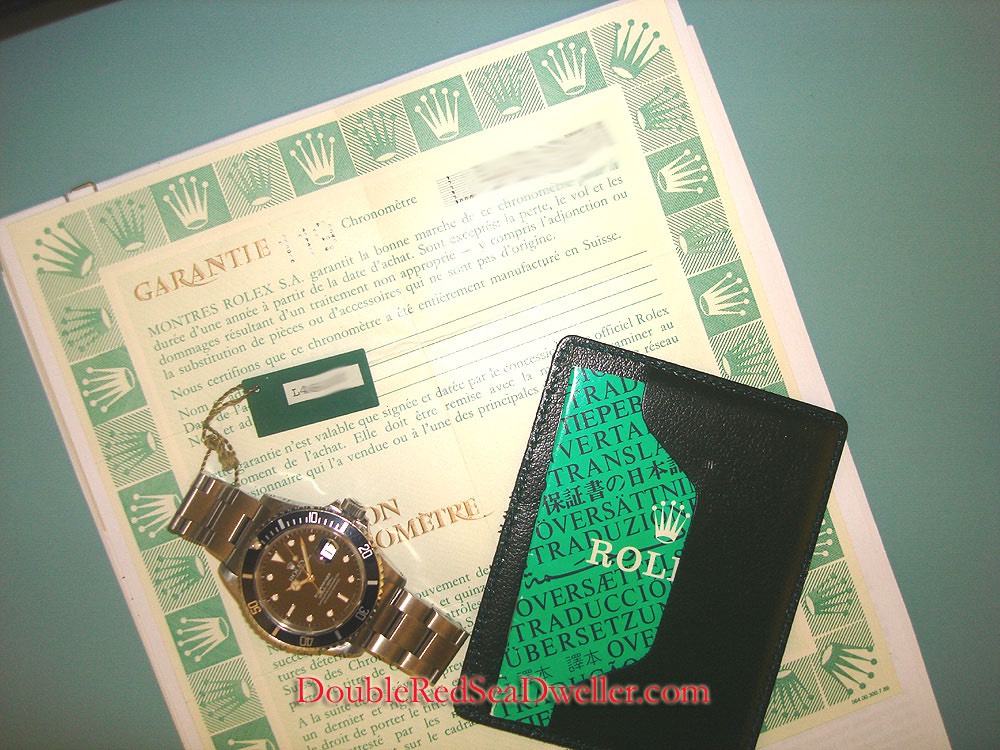
The documentation for this example is exceptional. The papers are punched with the serial number and a special dealer code of 119 — reserved exclusively for French special deliveries — with no names appearing on the paperwork. Service papers from Rolex France, issued a few years after original delivery, are also included.

Original Papers · Punched Serial · Code 119 — French Special Deliveries · Rolex France Service Papers
Photos Ed Delgado
Caseback Engraving
Issue number XX (IFREMER-applied)
Dealer Code on Papers
119 — French special deliveries only
Papers
Punched serial · No names · Rolex France service papers included
Modifications
None — standard 16610 production case
Additional Provenance
Researcher correspondence · Email exchanges · Dive logs · Deep sea research records · Photograph of researcher wearing the watch aboard a research vessel
Researcher Documentation · Dive Logs · Vessel Photograph · Email Correspondence
Photos Ed Delgado
Additional documentation comes directly from the researcher: exchanges of emails and dive logs, deep sea research records associated with the diver’s missions, and a photograph of the researcher wearing the watch in front of a research vessel — a complete and compelling provenance chain rarely seen on issued pieces of this type.