
GMT-Master · Transitional Era · Ref. 16750 · 16760 · 16700
GMT in Transition
GMT Masters: The Transitional Years
It is more than a little ironic that after remaining essentially unchanged for over 20 years, no other model of Sports Rolex went through as many permutations during Rolex’s “transitional period” as the GMT-Master. With the discontinuation of the venerable reference 1675 circa 1980, Rolex seemed to make up for lost time by trying out several new models with unique features in relatively rapid succession before finally settling on a clear course for the GMT.
Ref. 16750
Ref. 16750
Introduced 1980
Cal. 3075
Quickset Date
After embracing the fast beat/quickset date revolution of the late 1970s for their professional line of diving watches, the refs. 16660 Sea-Dweller & 16800 Submariner, Rolex introduced these same movement upgrades to a new reference of GMT-Master, the 16750.

Ref. 16750 — Photo courtesy of mike950
Introduced in 1980 to replace the ref. 1675, the new GMT was virtually identical to its illustrious predecessor, with its familiar choice of blue/red “Pepsi” or black bezel inserts, matte dial & acrylic crystal (although somehow the watch was now depth rated to 100 meters of water resistance, up from 50m on the 1675). But beneath the hood, the 16750 sported a new cal. 3075 movement with a 28.8k bph rate (as compared to 19.8k for the previous cal. 1575) & the convenient quickset date feature.
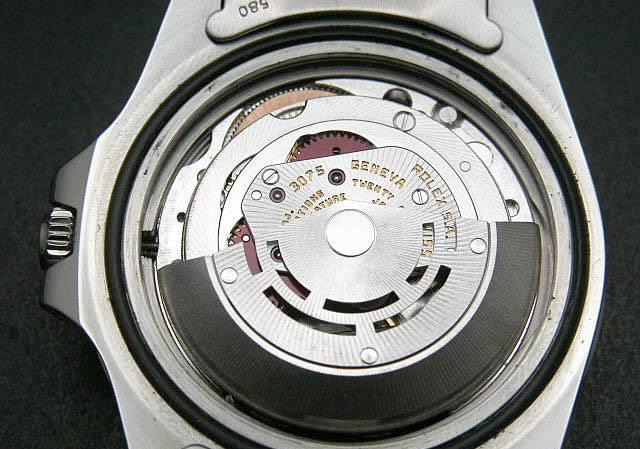
Cal. 3075 Movement — Photo courtesy of Clifton
Interestingly, while the stainless steel and two-tone (16753) models both retained the familiar acrylic crystal, the solid gold version (16758) featured a synthetic sapphire crystal like those mounted on the new generation of Sub & Sea-Dweller as a kind of “deluxe” bonus feature.

Ref. 16750 — Brochure photo courtesy of Wolfgang
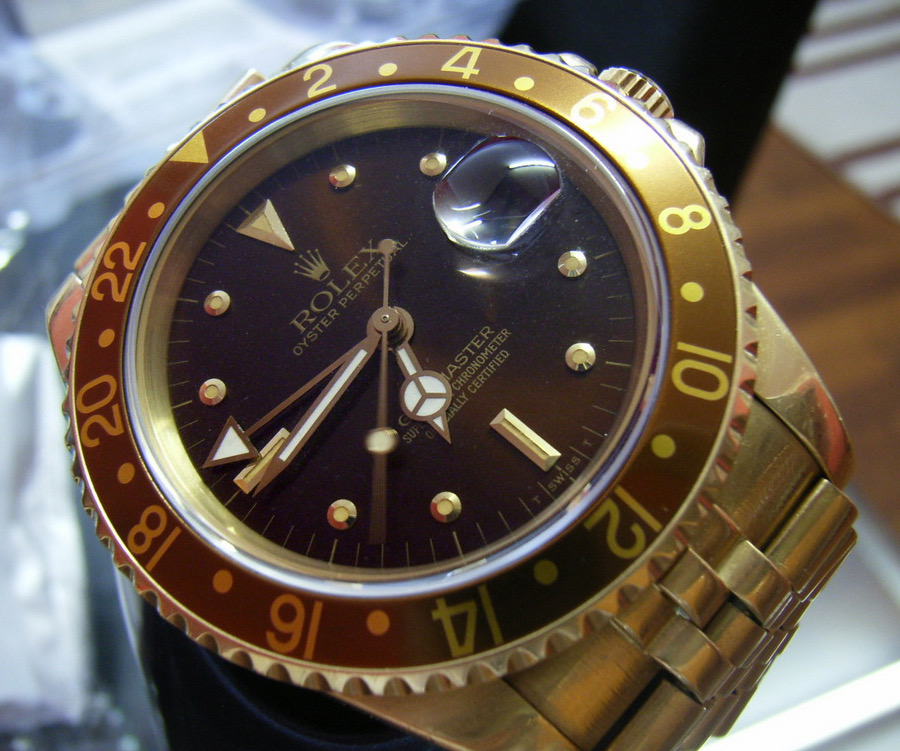
Ref. 16758 18k Gold — Photo courtesy of John the crocodileman
Eventually during the course of 16750 production, as it had with the transitional Sub & ‘Dweller, Rolex switched to a glossy dial with white gold surrounds (around 1985). Additionally, glossy dials frequently replaced matte dials when the watch was sent in for service. Therefore, finding a 16750 with its original matte dial is somewhat rare today. One interesting dial characteristic that the matte 16750s seem to share is the exceptionally tall/elongated coronet.

Ref. 16750 Matte Dial — Photo courtesy of Tim/cargoeng
Reference
16750
Introduced
1980
Movement
Cal. 3075 · 28.8k bph
Crystal
Acrylic (SS/TT) · Sapphire (Gold)
Bezel Options
Pepsi · Black
Water Resistance
100m
Variants
16750 SS · 16753 Two-Tone · 16758 Gold
Dial Transition
Matte → Gloss/WG surround c. 1985
Ref. 16760 — The “Fat Lady”
Ref. 16760
GMT-Master II
1983–1988
Cal. 3085
Independent Hour Hand
In 1983, Rolex introduced the revolutionary GMT-Master II, the original version of which bore reference 16760.
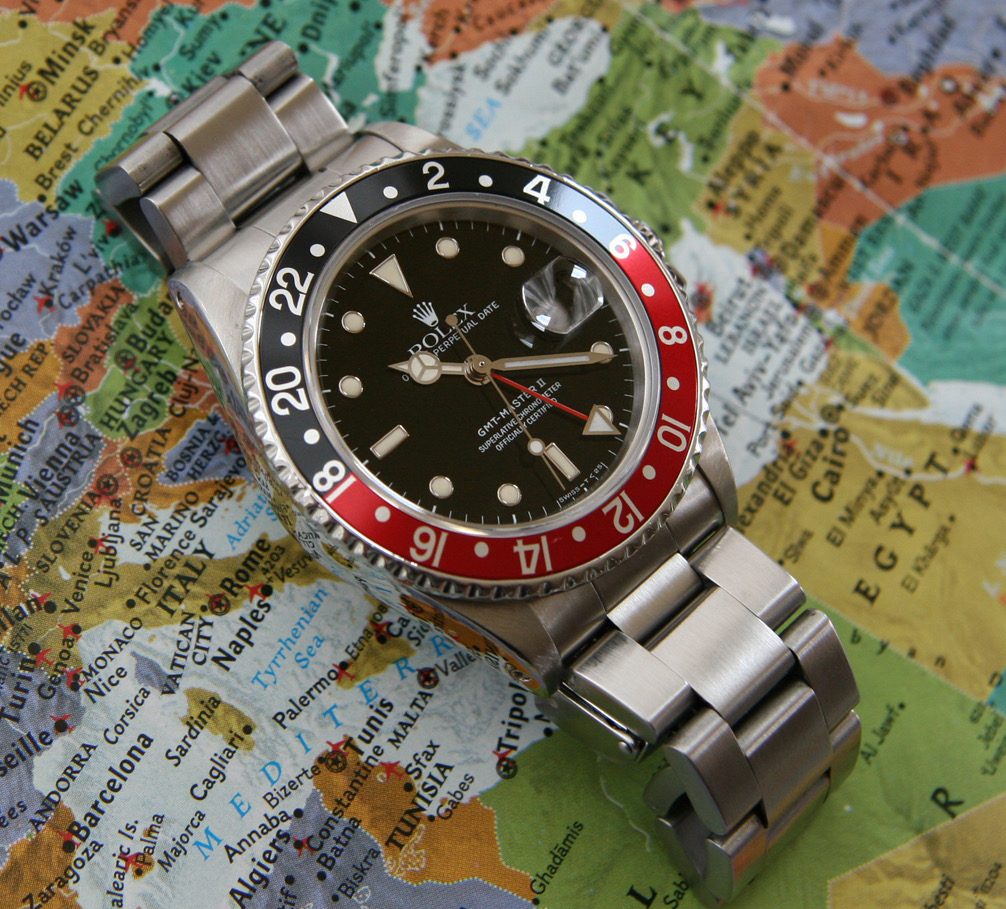
Ref. 16760 GMT-Master II
At last delivering on the logical next step for a multi-time zone watch, the 16760 featured the new cal. 3085 movement, which de-linked the hour hand from the large triangle 24-hour hand for instantaneous setting of the second time zone on the face of the watch itself (the quickset date was sacrificed for this exciting feature).
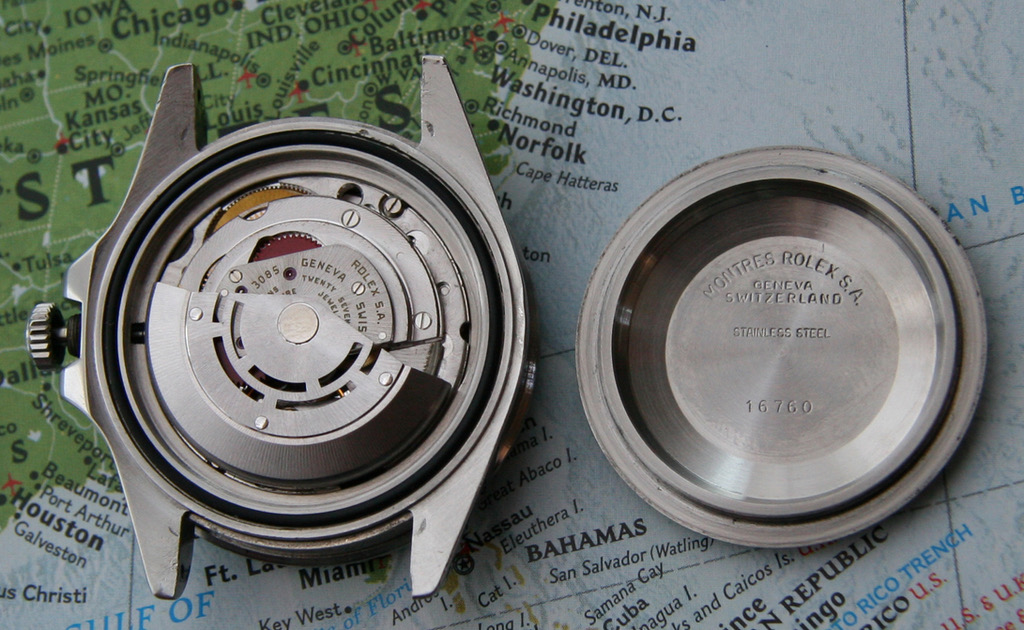
Ref. 16760 — Movement detail
Further, the seconds hand only hacked when the crown was pulled all the way out to the standard time-setting position, while it continued running when merely setting the hour hand to the new destination time. This enabled the GMT-Master II to maintain the legendary Rolex accuracy without interruption while traversing the globe. And now, since home time & local time could be read simultaneously on the face of the watch, the rotating bezel could be used to calculate a third time zone if needed.
But the movement was not the only new feature on the 16760. The watch was also the first GMT to be produced exclusively with a sapphire crystal. The rotating bezel, while remaining bi-directional of course, now had a ratcheting action. Interestingly, the only bezel insert offered on the original GMT-II was a new color combination of black & red. The 16760 was never offered in gold or steel & gold and was always fitted with a gloss/WG surround dial.
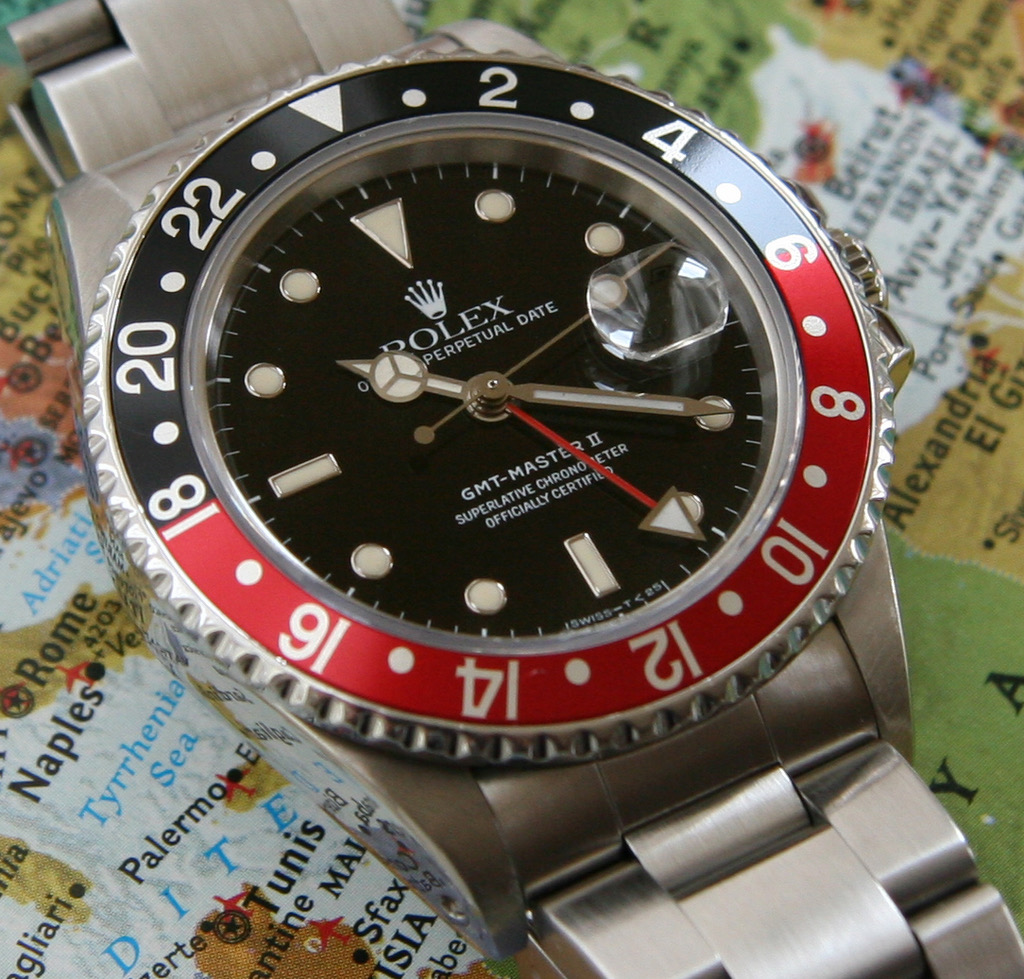
Ref. 16760 — Close-up detail
Even more interestingly, the 16760 GMT-II boasted an extra-thick case, some .5mm thicker than its predecessor, as well as a thicker bezel & crown guards. This has led to the affectionate nicknames “Fat Lady” and “Sophia Loren” in a nod to the 16760’s zaftig proportions.
One can see in this comparison with the 16660 Sea-Dweller just how thick the original GMT-II’s case actually was:

Ref. 16760 vs 16660 Sea-Dweller — Case thickness comparison
Produced only until 1988, the short-run 16760 was replaced by the much longer running ref. 16710 GMT-Master II. Not only did the 16710 sport a new caliber of movement (the identically functioning cal. 3185), but it had also lost weight and returned to more slender, GMT-like dimensions.

Ref. 16710 vs 16760 comparison — photo courtesy of mike950
(Rumor has it that the stalwart ref. 16710 may itself soon be replaced in 2007 by the gigantic, ceramic bezel 116710 GMT-II in Stainless Steel.)
Reference
16760
Production
1983–1988
Movement
Cal. 3085 · Independent hour hand
Crystal
Sapphire (first GMT-II)
Bezel
Black & Red only · Ratcheting
Case
Extra thick (+0.5mm) · Nickname: “Fat Lady”
Metals
Stainless Steel only
Dial
Gloss/WG surround only
Ref. 16700
Ref. 16700
c. 1988–1999
Cal. 3175
Stainless Steel Only
In a somewhat puzzling move, Rolex decided not to designate the GMT-Master II and its revolutionary innovations as the exclusive representative of the GMT line. Rather, they retained and transformed the old non-independent hour hand version with a new case, sapphire crystal, ratcheting bezel and gloss/WG surround dial.

Ref. 16700 — Photo courtesy of Alun
Introduced circa 1988, the ref. 16700 replaced the ref. 16750 in the Rolex catalog while remaining less expensive than its more evolved sibling, the GMT-II. Featuring the updated cal. 3175 (which functioned identically to the previous cal. 3075), the 16700 was sold until the remarkably late date of 1999, although overall production seems relatively small in comparison to the more advanced & functional 16710 GMT-II. Also, it appears that the 16700 was only offered with the Pepsi bezel insert but there is some information that shows that the black insert was also available and to distinguish it from the GMT-II (though it’s certain changes to the insert could be made on customer request).
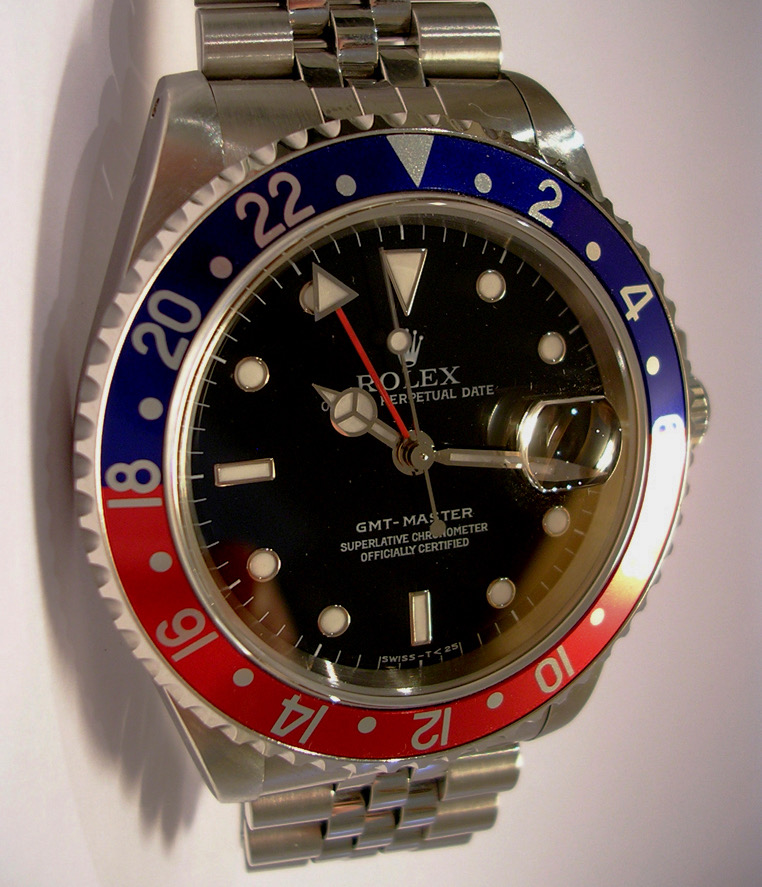
Ref. 16700 — Photo courtesy of Alun
The ref. 16700 was also only available in Stainless Steel.
There are some claims of matte-dialed 16700s, but due to the late date of the introduction of the reference — ca. 1988 — by which time the entire Rolex Sports line had converted to gloss/WG dials, this must be considered extremely rare at best and not particularly believable at worst.
Reference
16700
Production
c. 1988–1999
Movement
Cal. 3175 (functionally = Cal. 3075)
Crystal
Sapphire
Bezel
Pepsi (primary) · Black (rare)
Metals
Stainless Steel only
Dial
Gloss/WG surround
Hour Hand
Non-independent (same as 1675/16750)
The Future & the Past
As the long running “modern” 16710 GMT-II prepares to be replaced in the inevitable Rolex evolution by the “bigger, better” 116710 LN, it pays to remember that for Rolex, the only constant is change. If one needed any proof of that maxim, simply look back to the 1980s when, in replacing the 1675 as virtually the sole standard bearer of the line from 1959 to 1980, Rolex rolled out a remarkable 4 references of GMT — truly a time of transition for the GMT-Master.
4 References in One Decade: 1675 → 16750 → 16760 → 16700 → 16710. A remarkable period of evolution for any sports watch line.
Acknowledgments: Many thanks to Werner/Gatsby & Oskar/O.E., Tim/cargoeng & John/fatboyharris for lending their technical expertise and Rolex knowledge to this article and thanks to all who contributed their photos — it is much appreciated! tomvox1