
Rolex Daytona — Reference 16520 — Tropical Variant
16520 Patrizzi Dials
The Patrizzi Dial — Compax Marrone
Some of the black dialed Daytonas had been getting quite popular and their popularity reached an all time high when Italian collector Osvaldo Patrizzi sold his Rolex collection in 2006. His collection included a 16520 black dialed Daytona which had a brown discoloration in the subchapter rings. This discoloration was seen in some versions of the Mark IV dials and were subsequently called “Patrizzi Daytonas.” The watch attracted a lot of attention and sold for more than twice the cost of most normal Daytonas.
Collector Note — Compax Marrone
The “Patrizzi” name comes directly from Osvaldo Patrizzi, the Italian collector and auctioneer whose 2006 sale brought worldwide attention to this tropical subdial phenomenon. The Italian term Compax Marrone — “brown chronograph” — is used interchangeably in European collector circles.
The Discoloration
There is some discussion about the black dialed S, N, T and W serial Daytonas which, from a manufacturing defect, caused the color of the subdials to fade to brown or chocolate colors. It is postulated that this color shift happened due to ultraviolet light exposure and the materials used by Rolex at the time.
The brown shift affects only the subdial rings — not the main dial field — giving the watch its distinctive two-tone black-and-chocolate appearance that collectors prize so highly.
Affected Dial
Mark IV (black dial)
Known Affected Serials
S, N, T and W serials
Discoloration Location
Subdial / subchapter rings only
Color Shift
Black → brown / chocolate
Postulated Cause
UV light exposure & period materials
Name Origin
Osvaldo Patrizzi auction, 2006
Auction Premium
2× or more vs. standard example
Italian Term
Compax Marrone
S Serial
N Serial
T Serial
W Serial
Mark IV Dial
Black Dial Only
Reference Photos
Photo by Andrea

16520 Patrizzi — brown subdial discoloration, photo by Andrea
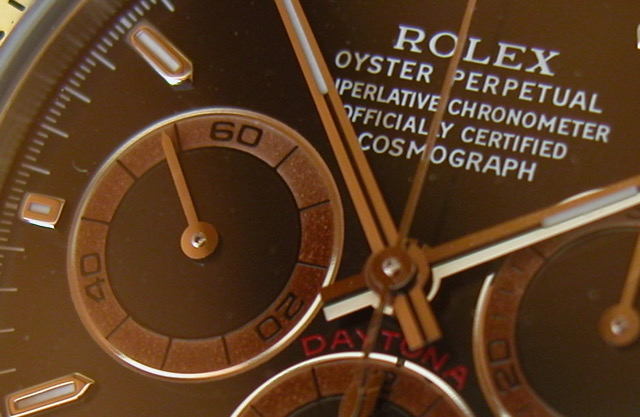
Compax Marrone subdial detail

Patrizzi dial example
Collector Context
The Patrizzi phenomenon is a direct parallel to the “tropical” dials seen on vintage Submariners and Sea-Dwellers — where the passage of time and environmental factors transform an originally uniform dial into something wholly unique. In the 16520 world, no two Patrizzi examples are identical: the degree of browning, the evenness of the shift across the three subdials, and the contrast against the main black field all vary from watch to watch.
The most desirable examples show an even, deep chocolate brown across all three subdials with no patchiness. Asymmetric fading — where one subdial browns more heavily than the others — is common and considered less desirable, though still a significant premium over a standard black dial example.
Authentication Note
Because of the large price premium, Patrizzi fakes exist. Artificially darkened or chemically altered subdials have been documented. Always examine the transition zone between the subdial ring and the main dial field under magnification — genuine UV aging produces a gradual, organic edge rather than a sharp chemical line.