
Reference 1680 · Single Red · c. 1967–1983
The Red Submariner
Overview
The Rolex 1680 reference stands among the all-time favorite vintage Rolex sport models to own, collect and wear. Occupying the same genre as the Double Red Sea Dweller, Daytona, Orange Hand and GMT, the 1680 is among the most attractive Rolex sport icons ever produced.
Much of the information gathered over the years about the 1680 Red Submariner was gathered from the buying process — including owning many examples whose pictures appear in this article.
This is not intended to be a history of the watch, but a collector’s preference and loose guide. The following information may not be absolute — discussion and corrections are welcomed. Many of the concepts apply equally to collecting other Rolex sport models from the same era.
Dial Varieties & Serial Ranges
The Red Submariner was produced with 7 different dial versions recognized by the collector community. Estimated production ranges based on collector experience:
Mark I
Meters First · 2.07M–2.2M
Mark II/III
Meters First · 2.2M–2.45M
Mark IV
Feet First · 2.45M–3.?M
Mark V
Feet First · 2.?M–3.?M
Mark VI
Feet First · 3.?M–4.0M
Mark VII
White Sub · 4.0M–7M+
Collector Rule: Do not buy a Red Sub with a case number above 4M, or a Meters First dial with a case number higher than 2.5M.
Mark II/III dials appear simultaneously — there is no way to distinguish which came first. It is not uncommon to find a later dial version in an earlier watch case due to service history. A much earlier dial in a much later case raises serious red flags — likely a Frankenwatch.
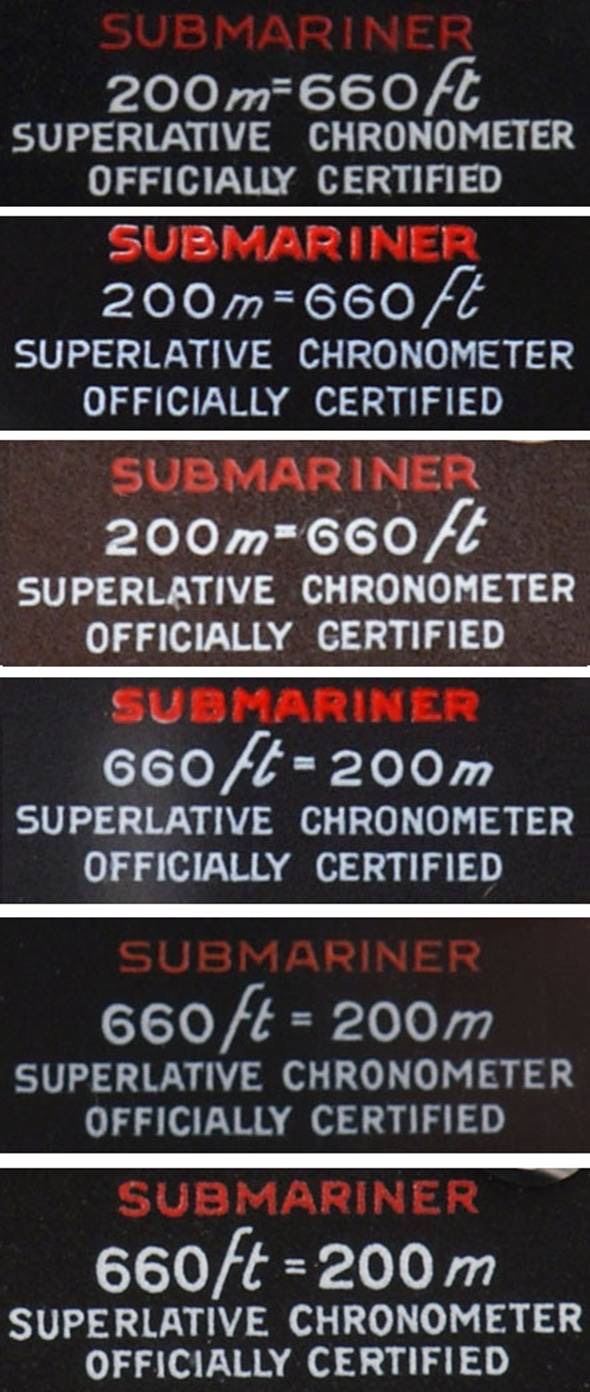
Dial Variation Chart — Mark I through Mark VI comparison
Dial Mark Characteristics
Mark I · Meters First
- Red lettering over white
- Elongated closed 6’s
- Long & curvy “F”
- Distinctive condensed font
Mark II · Meters First
- Same era as Mark III
- Black or Brown dial
- Red printing on white
- Open “6” · Thinner font
- Longer “F” than Mark III
Mark III · Meters First
- Same era as Mark II
- Black or Brown dial
- Red lettering printed direct
- Open “6” · Thicker font
- Shorter “F” than Mark II
Mark IV · Feet First
- Earliest Feet First dial
- Red lettering on white
- Distinctive open “6”
Mark V · Feet First
- Middle Feet First dial
- Red lettering direct on dial
- Less pronounced open “6”
Mark VI · Feet First
- Last Feet First dial
- Red lettering printed
- Closed “6”
- “S” looks rounded, not flat
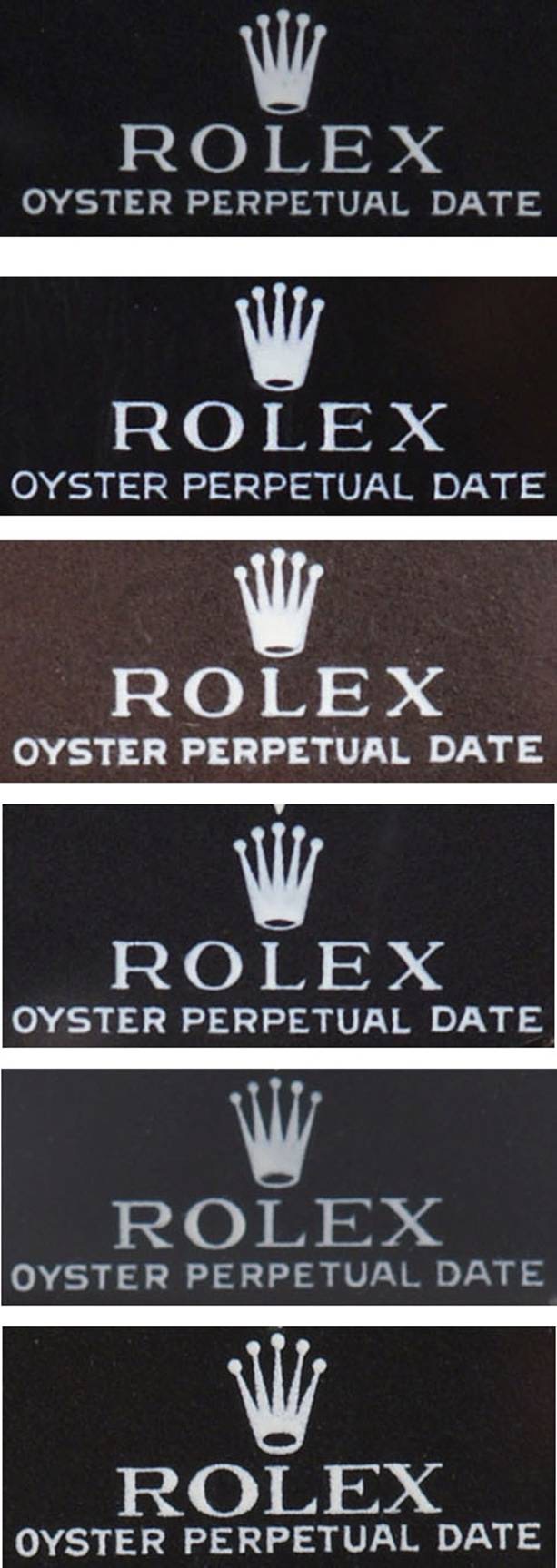
Coronet comparison — Mark I through Mark VI
The Chocolate Sub — Brown Dial Variants
The Brown Sub variant, as rare as it is beautiful, was most likely spawned from a manufacturing flaw. This makes it highly sought by collectors worldwide — a true “grail watch.”
Brown dial Subs are only found in Meters First Mark II & Mark III dials, typically in case numbers in the 2.2M–2.3M range. They are ultra rare: only a small fraction of dials turned brown, and many were destroyed or replaced during service.
Dials turned brown due to unstable materials used in manufacture. The original paint was intended to be black but changed due to improper mixing ratios or chemical impurities. Environmental factors — light exposure, temperature, humidity — determined intensity. The color change process occurred in the first few years and is not ongoing.
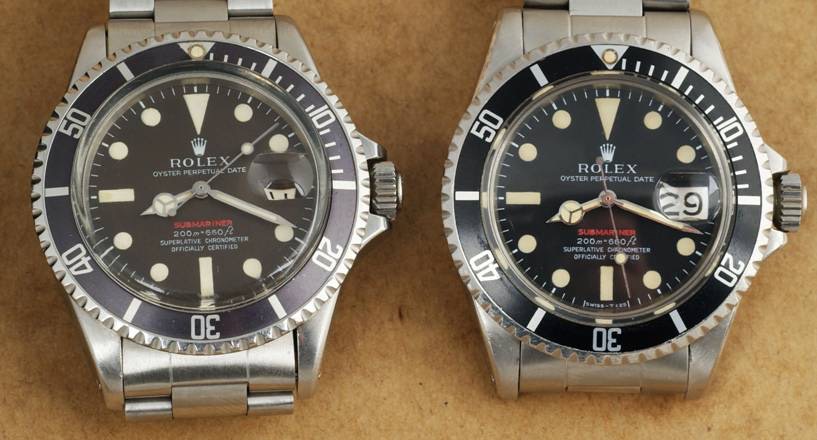
Mark II Brown Dial (L) & Black Dial (R)

Mark III Brown vs. Black comparison
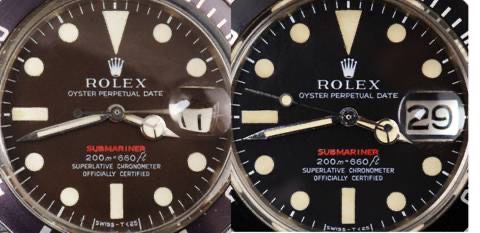
Mark II Brown vs. Black — second comparison
Patina — Scale & Desirability
Watches worn regularly did not turn yellow or develop patina. Watches stored unworn turned color — the degree depending on light exposure and environmental factors. The aging process stopped after several years and is not ongoing.
Patina Scale Reference:
0
Stark White
1
Off White
2
Light Yellow
3
Golden (Creamy)
4
Darker Yellow
5
Brown (sim.)
6
Brackish (sim.)
Watches with strong even patinas (3 & 4) are highly sought by collectors and bring strong premiums. Look for evenly colored markers — dark spots or streaks (marbling) are undesirable.

Patina scale reference — 0 (Stark White) through 6 (Brackish)
Dial Imperfections
Due to natural aging, minor dial defects are acceptable and unavoidable when collecting Red Subs. Small broken hash marks where the case meets the dial are the most common minor imperfection — so common they are one of the “tells” used to confirm authenticity. Tiny chips where the dial meets the case are also fairly common. Tritium loss on markers is acceptable. The red writing on Mark I, III and IV dials is almost always slightly imperfect due to the printing process — some white showing at the edges of letters is normal.
Avoid dials with aftermarket or refinished printing, or with relumed markers — these trade at steep discounts and are very low demand among serious collectors.
Hands & Inserts
Hands should match the patina on the dial. If they do not match, have been relumed, or changed to Luminova, it can be an eyesore — though hands can be replaced with patience. Most collectors prefer matching tritium hands that do not glow.
The most desirable inserts are the “Fat Fonts” — factory originals. Attractively faded Fat Font inserts command dramatic premiums even when scratched. Thinner font service replacement inserts do not fade and are still available from Rolex today — usable, but they do not enhance the look. The Pearl dot on the insert is a bonus; most lost their luminous material long ago but they can be replaced.

Fat Font insert — nicely faded example

Font thickness varieties — service replacement 2nd from right
Case
Next to the dial, the case is the second most important and valuable component. Unlike hands or an insert, a case cannot easily be changed or improved. It is very rare to find a Red Sub with an unpolished case.
Unpolished cases are treasured finds — a very strong premium is warranted even if the watch has other inferiorities.
Case Engravings
All digits must be present and legible under loupe. Full case number must be discernible as a minimum requirement.
Lugs
Check for uneven thickness. Over-polishing can make one lug thinner than the others.
Crown Guards
Check for “pinch” from polishing. Compare both sides for symmetry.
Pitting / Corrosion
Slight pitting is normal. Excessive corrosion or obliterated case digits — avoid.
Caseback Date Codes
2M–3.4M serials stamped “II 69” through “II 72.” Post-3M: date code dropped. 1973 onward: no date code.
Crown Type
Under 3M: Twin Lock (no dots). Post-1973: Triplock (3 dots). Original Twinlock adds a small authenticity premium.
Bracelet
Bracelets are easily changed and should not be evaluated critically. Five bracelet models are compatible with Red Subs:
7206 Swiss Made
Early Red Subs · 80 end pieces
9315 Folded Link
“Correct” bracelet · 280/380 end pieces · clasp dated 67–72 · Patent Pending version (67–70) most valuable
USA Made Riveted
No model number · no diver extension or flip lock · dated clasp 1960s–1970s
7836 Folded Link
Designed for GMT/Explorer II · fits Red Sub perfectly · 280/380 end pieces · no flip lock or diver extension
93150 Solid Link
Introduced late 1970s · 580 end pieces · most comfortable for daily wear · links removable with small screwdriver
Movement
Calibre
Rolex 1575 (rotor bridge engraved “1570”)
Date Function
1575 = 1570 base movement + date complication
Shared With
1675 GMT · 1655 Explorer II · 1665 Sea-Dweller
Collector Note
Parts easily sourced — do not rely on movement to verify authenticity. Buy original condition and service to your own standard.
Box, Papers & Provenance
Papers are not for everyone. If you simply want a nice watch at the lowest price and are not seeking an investment, buy a nice loose Red Sub and enjoy it. Papers are for serious collectors seeking investment-grade pieces.
The premium is warranted only for PUNCHED GREEN CERTIFICATES with a matching case number. Handwritten papers or blank papers do not carry the same premium.
Around the 2.8M case number, Red Subs switched to the larger green-border certificate printed on thinner paper with the Rolex watermark. Earlier examples came with the smaller thick-stock green paper. Concentrate on the dial condition and punched papers — boxes and accessories can be sourced separately.

Earlier small green punched certificate — thick stock, no watermark

Later large green-border certificate from ~2.8M serial — thinner stock with Rolex watermark
Collector’s Buying Tip
“Buy the seller, not the watch.” Never purchase without the right to return, or from someone you do not know. Work with a seller who knows Red Subs intimately.
It is impossible to authenticate a watch to be 100% genuine from pictures alone. Look for sellers with a no-hassle return policy and a reputation they want to protect. Generalist dealers who trade many models can easily make mistakes — and proving a fake is an uphill battle even with obvious evidence. Even Rolex will refuse to take sides on your behalf.